
Early Action (EA) is an application option that lets students apply to colleges earlier than the regular deadlines—usually in October or November of senior year—and get an admission decision sooner, often by mid-December or January. The big appeal is that students get answers earlier without having to commit right away.
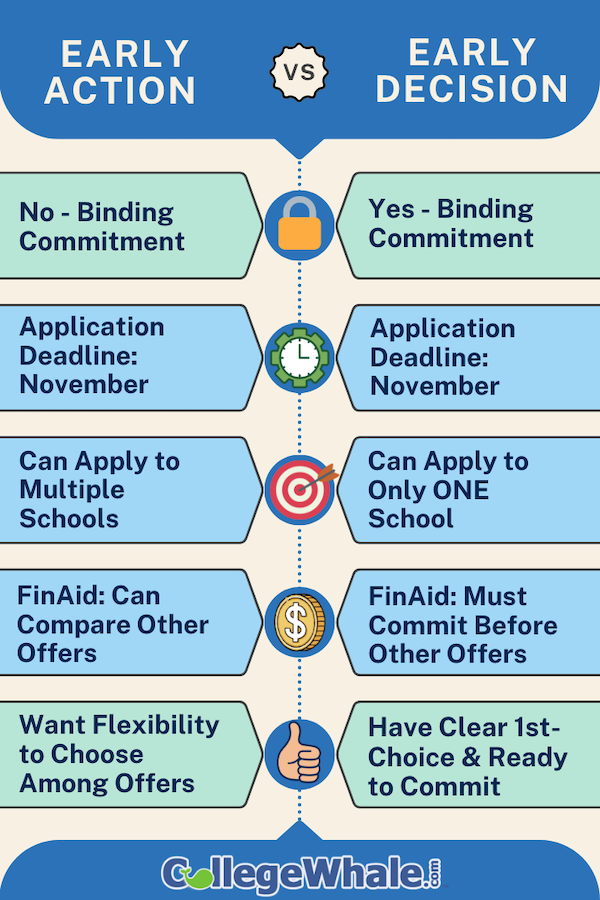
The key feature of Early Action is that it’s non-binding. If a student is admitted under EA, they do not have to say “yes” right away. They still have until the national decision deadline of May 1 to compare financial aid offers, hear back from other schools, and make a final choice. For students who are organized and ready to apply early—but aren’t ready to commit to just one school—EA can be a very comfortable option.
Most colleges allow students to apply to multiple schools through Early Action. A few highly selective schools offer something called Restrictive Early Action (REA) or Single-Choice Early Action (SCEA), which limits where else a student can apply early, especially to other private colleges. Even in those cases, however, the admission offer is still non-binding—the student is not required to attend if accepted.
Early Action tends to work best for students who already have strong grades through junior year, solid test scores (if they’re submitting them), and a clear idea of which schools they’re seriously considering. It can also help show interest in a college without giving up the chance to compare options later.
Early Decision (ED) is another early application option, but it works very differently from Early Action. Students still apply early—usually in November—and hear back around December. The crucial difference is that Early Decision is binding. If a student is admitted ED, they are expected to enroll at that college and withdraw all of their other applications.
Because of this, ED is meant for students who have a clear first-choice school and have already done their homework on fit—academic, social, and financial. Applying ED signals to the college that, if admitted, the student fully intends to attend. At some selective schools, this clear level of commitment can offer a small admissions advantage.
That said, the financial side of ED deserves careful attention. When a student is admitted ED, they receive one financial aid offer from that school and usually have to make a decision before seeing offers from anywhere else. Families can use the school’s Net Price Calculator ahead of time to get a rough estimate of cost, but it’s still an estimate. If the official aid package turns out to be truly unaffordable, families can sometimes appeal or ask to be released from the ED agreement, but that’s handled case-by-case and isn’t guaranteed.
Another important rule: students can only apply to one college under Early Decision. They may still apply to other schools under non-binding Early Action or Regular Decision, but if they are admitted ED, they must commit to that school and withdraw their other applications.
In short, Early Decision can be a good option for students who feel confident they’ve found “the” school and who have a clear understanding of the potential cost. It’s a powerful tool, but the commitment should be made thoughtfully and with the whole family on the same page.
This is a very common question: can a student apply to both Early Action and Early Decision in the same cycle? The answer is “yes, sometimes”—but there are important limits.
Students may apply to only one school through Early Decision because ED is a binding agreement. Applying ED to more than one college at the same time breaks that agreement and can lead to offers being rescinded if schools find out.
However, students can often apply to other colleges under non-binding Early Action while also applying to one school through Early Decision. For example, a student might apply ED to a top-choice private college and EA to one or more public universities. If the student is admitted ED, they are expected to enroll there and let the EA schools know they won’t be attending. If they are deferred or denied from their ED school, the EA and Regular Decision applications remain in play.
The main wrinkle involves schools that use Restrictive Early Action (REA) or Single-Choice Early Action (SCEA). These are non-binding but often come with rules that limit applying early to other private colleges. Many still allow early applications to public universities or international schools, but the exact rules vary by institution.
Because policies differ from school to school, it’s always wise to read the early application guidelines carefully and contact the admissions office if anything is unclear. As a general rule, you can apply to:
Understanding these boundaries helps students build a smart early strategy without accidentally breaking any agreements.
When families think about Early Action versus Early Decision, it’s important to factor in not just admissions strategy, but also financial aid. The timing and binding nature of each option can affect how much flexibility you have when comparing costs.
With Early Decision, students receive an admission decision and financial aid offer from one school early—and are expected to commit before seeing what other colleges might offer. That can work well for families who feel confident about the school’s affordability based on net price estimates and who don’t need to compare multiple aid packages. For families who are depending heavily on need-based aid or merit scholarships, however, ED can feel risky because it limits the ability to “shop around.”
If the ED offer is significantly lower than expected, families can talk with the college’s financial aid office and ask for a review. In some cases, if the numbers truly don’t work, students may be released from the ED commitment. But this isn’t guaranteed and should not be assumed as a safety net.
With Early Action, the financial picture is more flexible. Students can:
Because EA is non-binding, students have the full timeline—up to May 1—to weigh both academic fit and cost. For many families, especially those whose budgets are a major factor, Early Action is the more comfortable option.
In general, ED tends to make the most sense when:
Early Action tends to be better for families who want:
Neither approach is automatically “better”—the right choice depends on each student’s priorities and each family’s financial comfort level. The most important step is to understand what you’re agreeing to before you hit “submit.”
These articles help parents make sense of college costs, financial aid decisions, and borrowing tradeoffs — without the overwhelm. For a broader overview of planning and paying for college as a parent, see our overview of College Planning for Parents.


